











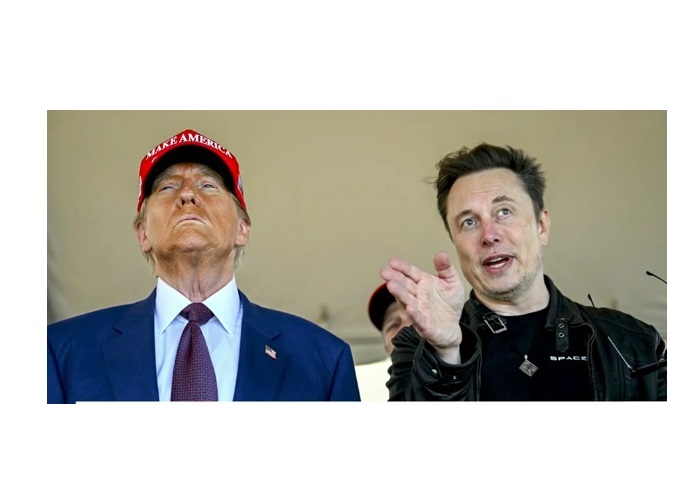
The unlikely alliance between President Donald Trump and tech titan Elon Musk has spectacularly imploded, triggering a very public feud with potentially far-reaching consequences. What began as a surprising partnership, seeing Musk take on a role within the Trump administration to streamline government efficiency, has dissolved into a war of words, leaving investors, politicians, and the public wondering what’s next.
The Spark: A “Big, Beautiful Bill” and Public Barbs
The immediate catalyst for the fallout appears to be Musk’s scathing criticism of a significant spending bill championed by President Trump. Musk, known for his often unfiltered pronouncements on X (formerly Twitter), branded the legislation an “abomination” and financially reckless. This public denouncement drew a swift and sharp rebuke from Trump, who, never one to shy away from a fight, retaliated by threatening to revoke government contracts and subsidies benefiting Musk’s companies.
The verbal sparring quickly escalated, with Musk making unsubstantiated claims about Trump’s involvement in the Jeffrey Epstein files, and Trump questioning Musk’s mental state. This raw, unfiltered exchange on social media has put a spotlight on the complex interplay between business interests, political influence, and personal rivalries at the highest echelons.
Tesla in the Crosshairs: A Volatile Ride for Investors
One of the most immediate and visible impacts of this feud has been on Tesla. Following the public spat, Tesla’s stock experienced a significant plunge, at one point losing approximately 14% of its value and wiping out billions from Musk’s personal net worth. While the stock has seen some recovery, the volatility underscores the market’s sensitivity to this high-profile conflict.
The concern for Tesla investors is multifaceted:
- Government Contracts and Subsidies: Trump’s threat to cut off government contracts and subsidies is a significant worry. Tesla, along with SpaceX, benefits from substantial federal grants and incentives, particularly in areas like electric vehicle tax credits. The potential elimination of the $7,500 EV tax credit, for instance, could cost Tesla over a billion dollars annually. While the practicalities of immediately terminating such contracts are complex and could involve lengthy legal processes, the uncertainty alone creates a negative investment climate.
- Regulatory Scrutiny: Musk’s companies, including Tesla, already face numerous investigations from various government agencies. A hostile White House could intensify this scrutiny, leading to further regulatory hurdles and potential legal challenges, particularly concerning Tesla’s ambitious plans for autonomous vehicles and robotaxis.
- Reputational Risk: Musk’s political alignment and controversial public statements have previously led to consumer boycotts of Tesla vehicles. While some analysts believe a public split with Trump could potentially bring back environmentally-minded buyers, the ongoing public drama adds an element of unpredictability and reputational risk to the brand.
- Expansion Plans: Tesla’s global expansion plans, particularly in markets like India, could also face turbulence. With the political backing of one of America’s most influential figures seemingly gone, favorable deals in foreign markets might become harder to secure.
Beyond Tesla: What Else is at Stake?
The Trump-Musk fallout extends far beyond Tesla’s stock price, posing broader implications:
- Political Funding and Influence: Elon Musk has been a significant financial backer of Donald Trump and the Republican Party, contributing hundreds of millions of dollars to their campaigns. A sustained rift could see this crucial funding disappear, impacting Republican efforts in upcoming elections. Musk has already hinted at forming a new political party to represent the “80% in the middle,” further underscoring the potential for a seismic shift in political landscapes.
- SpaceX and Government Partnerships: SpaceX relies heavily on government contracts, particularly with NASA for ferrying astronauts and supplies to the International Space Station, and with the Department of Defense. While Musk initially threatened to decommission SpaceX’s Dragon spacecraft in retaliation, he later backtracked. However, the threat highlights the vulnerability of these vital partnerships if the conflict remains unresolved.
- Broader Business Environment: The dispute sends a chilling message about the potential weaponization of government power against perceived enemies. It could create an environment of uncertainty for other businesses and entrepreneurs who might fear similar political repercussions for their opinions or associations.
- The Future of “Government Efficiency”: Musk’s role in the “Department of Government Efficiency” (DOGE) was a cornerstone of his initial alignment with Trump. The effectiveness and future of such initiatives, particularly those spearheaded by politically aligned private sector leaders, are now called into question.
The Path Forward: Resolution or Escalation?
As of early June 2025, the feud shows no immediate signs of abatement. While both sides have reportedly de-escalated some of their public attacks, the underlying tensions remain. The question for many is whether this is a temporary “white-knuckle period” that will eventually settle, or a permanent fracture with lasting consequences.
The stakes are high. For Tesla, continued political uncertainty could hinder its ambitious growth plans and alienate investors. For the Republican Party, the loss of a major financial backer could create significant challenges. And for the broader American political and business landscape, the unresolved conflict serves as a stark reminder of how intertwined personal rivalries, corporate interests, and national policy can become. The coming weeks and months will reveal whether a truce can be brokered or if this billionaire brawl will continue to reverberate across markets and political spheres.