











From journalism in China to the international artificial intelligence industry, the reported journey of Alice Huang has raised questions about business connections, powerful technology companies and the global race for advanced AI chips.
Few stories illustrate the intersection of technology, international business and geopolitics quite like the controversy surrounding Alice Huang.
Her name has attracted attention following reports linking her to NVIDIA chief executive Jensen Huang, a company executive whose influence extends across the global artificial intelligence industry. But beyond the personal headlines lies a much bigger business story involving Singapore, China, investment networks and access to some of the world’s most sought-after computer chips.
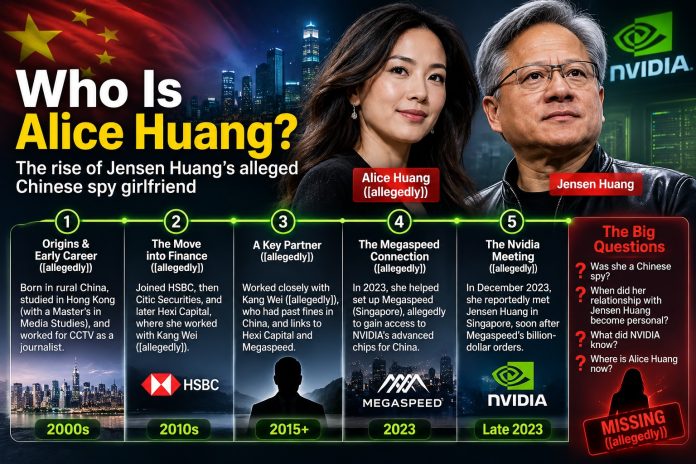
According to the investigation presented in the supplied CNBC video, Alice Huang was born in China’s Hunan province and later moved to Hong Kong, where she reportedly studied media and obtained a master’s degree. She is said to have worked as a television journalist for China’s state-owned broadcaster, CCTV, before making an unexpected move into finance.
Her reported career included positions at HSBC and CITIC Securities, followed by a role at Hexi Capital, an investment group with interests across different industries.
The connection that changed her career
The video identifies Kang Wei, the founder of Hexi Capital, as an important figure in Huang’s professional journey. It alleges that the two had a close personal relationship, although claims about their marital status remain unconfirmed.
Kang’s reported regulatory history in China has also attracted scrutiny. The video says he was fined twice for activities involving the acquisition of control over companies.
The next chapter involves Megaspeed, a Singapore-based business that reportedly shifted its focus towards artificial intelligence infrastructure.
This is where the story enters the highly competitive semiconductor market.
In 2022, the United States introduced restrictions on the export of advanced computing chips to China. These restrictions were intended to limit China’s access to technology considered strategically important.
The video alleges that Megaspeed subsequently positioned itself as a route through which Chinese businesses could access advanced NVIDIA chips. These claims have not been established as proven wrongdoing.
The NVIDIA connection
The investigation reports that Alice Huang met Jensen Huang at a dinner in Singapore in December 2023. It also claims that Megaspeed’s commercial relationship with NVIDIA expanded around this period.

However, a reported meeting does not establish that any personal relationship influenced business decisions or that NVIDIA knowingly facilitated an illegal transaction.
Questions that remain unanswered
The allegations surrounding Alice Huang raise important questions about corporate due diligence, international chip exports and the risks facing technology companies operating across borders.
Was Megaspeed properly scrutinised? What did NVIDIA know about its business partners? Were export restrictions respected? And what evidence supports the allegations of espionage?
These questions deserve answers based on verifiable evidence, not speculation.
Ultimately, this story is bigger than one individual. It highlights how access to advanced AI technology has become a matter of commercial power, national security and international competition.